This project profile page contains information about The Republic of Sierra Leone Armed Forces project including project results, impact, and effective practices. This page will be updated annually in line with EIF project reporting requirements.
| T/PCC | Updates | |||||||||||
| 2020 | 2021 | 2022 | 2023 | 2024 | 2025 | |||||||
| Total | % | Total | % | Total | % | Total | % | Total | % | Total | % | |
| Sierra Leone | 31 | 38.27% | 36 | 53.73% | 42 | 62.69% | 21 | 45.65% | 19 | 47.50% | 14 | 41.18% |
|---|---|---|---|---|---|---|---|---|---|---|---|---|
| Experts on Mission | 10 | 71.43% | 8 | 72.73% | 7 | 70.00% | 7 | 58.33% | 6 | 60.00% | 5 | 55.56% |
| Individual Police | 13 | 37.14% | 20 | 80.00% | 27 | 93.10% | 7 | 87.50% | 9 | 45.00% | 5 | 33.33% |
| Staff Officer | 8 | 25.00% | 8 | 25.81% | 8 | 28.57% | 7 | 26.92% | 4 | 40.00% | 4 | 44.44% |
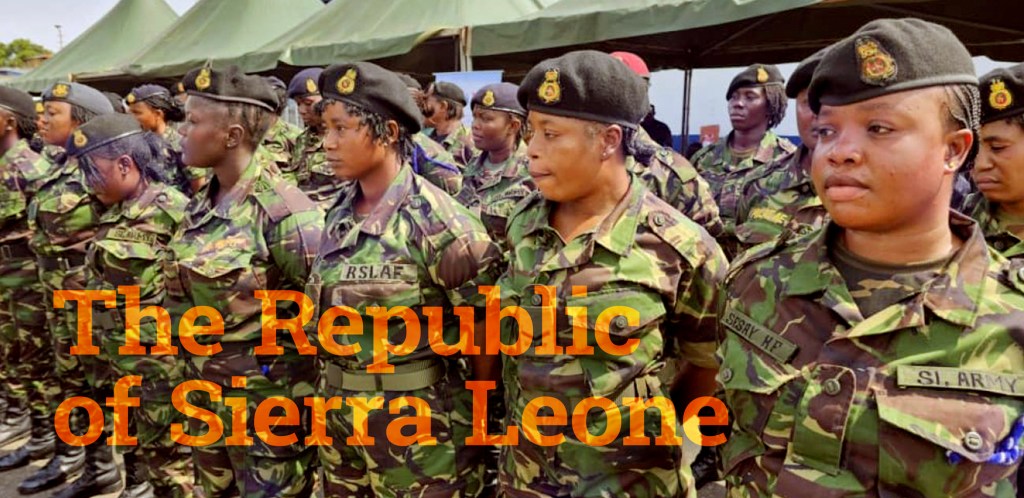
The Republic of Sierra Leone Armed Forces (RSLAF) is the country’s national defence force comprising the army, navy and air wing jointly constituting the national military. The institution is overseen by the Ministry of Defence and National Security. The President of Sierra Leone is Constitutionally the Commander-in-Chief of the RSLAF, and the Chief of Defence Staff is the highest-ranking officer and uniformed leader.
Having hosted United Nations Mission in Sierra Leone (UNAMSIL: 1999–2006), Sierra Leone now contributes to UN Peace Operations as an example of a country’s successful transition to a peaceful democracy. The RSLAF has contributed its Military Experts on Missions and Staff Officers to the United Nations Mission in South Sudan (UNMISS), United Nations Multidimensional Integrated Stabilization Mission in the Central African Republic (MINUSCA), United Nations Interim Security Force for Abyei (UNISFA), United Nations Interim Force in Lebanon (UNIFIL), The United Nations Mission for the Referendum in Western Sahara (MINURSO), United Nations Organization Stabilization Mission in the Democratic Republic of Congo (MONUSCO), United Nations Mission to Support the Hudaydah Agreement (UNMHA), the United Nations Transitional Assistance Mission in Somalia (UNTMIS), and the United Nations Truce Supervision Organization (UNTSO).
The MOWIP Barrier Assessment for RSLAF began in 2021, with the final report released in November 2023 under the Elsie Initiative Fund’s (EIF) first programming round. In response to identified barriers, RSLAF is currently implementing this Flexible Project jointly with UN Women in Sierra Leone to “reposition its women to meaningfully participate and lead in the Republic of Sierra Leone’s Armed Forces and to support peace operations.”
The Republic of Sierra Leone Armed Forces (RSLAF) has taken sustained steps to advance gender equality through its institutional policies and practices. This includes the establishment of the Gender and Equal Opportunities Directorate in 2009, which has led to the development of several key military policies. These include the Gender Policy (2009), the Sexual Harassment and Exploitation Policy (2013), and the Fraternisation Policy, all of which are designed to support and promote the meaningful participation of women within the RSLAF.
Pursuant to the findings of the 2023 MOWIP Barrier Assessment, and in direct response to the three highest-priority barriers identified and their corresponding recommendations, the RSLAF has committed to implementing the current Flexible Project with the following objectives:
1. To increase the representation and participation of women in senior leadership positions within the RSLAF and in deployments to United Nations peace operations through a review and revision of RSLAF gender affirmative policies in line with the Gender Equality and Women’s Empowerment Act 2022
2. To expand access to training opportunities that enhance the deployment readiness of female personnel within the RSLAF
3. To improve the retention of women personnel through strengthened gender – specific medical / healthcare services and effective reporting and response mechanisms for sexual and gender-based violence (SGBV) within the RSLAF
EIF Outcome 3
US$750,007
US$750,007
The Republic of Sierra Leone Armed Forces (RSLAF)
UN Women, Sierra Leone
24 months
10 June 2025
20 June 2025
16 June 2027
[nil]
24 months
This project is expected to achieve the overarching outcome of enhanced participation and leadership opportunities for women within the RSLAF, thereby strengthening the pool of eligible uniformed women available for peacekeeping deployments. This will be accomplished through the promotion and implementation of gender-responsive institutional policies, improved training facilities, strengthened healthcare services for female personnel, and enhanced accountability mechanisms for sexual harassment and abuse at the national level (supporting a shift in institutional culture within the RSLAF toward the prevention and effective response to Sexual Exploitation and Abuse and Sexual Harassment).
First Lady Fatima Bio Launches Elsie Initiative Fund to Support Uniformed Women in Peacekeeping, 19 August 2025
75 female soldiers begin all-female drivers training in Sierra Leone, 29 October 2025
Sierra Leone’s First Lady champions female soldiers’ advancement at launch of two-year Elsie Initiative, 20 August 2025
RSLAF And UN Women Launches Initiative to Empower Women in Peacekeeping, 08 July 2025
Sierra Leone launches initiative to empower women in peacekeeping, 08 July 2025
UN Women, RSLAF Launch Gender Reform as First Female Infantry Commander Makes History, 22 August 2025
RSLAF Launches Service Women’s Day to Promote Gender Equality in Military, 09 September 2025
UN Women, RSLAF, and Elsie Initiative Launch Historic All-Female Military Drivers Training, 29 October 2025
Sierra Leone Armed Forces MOWIP Barrier Assessment Report, 2023
English
