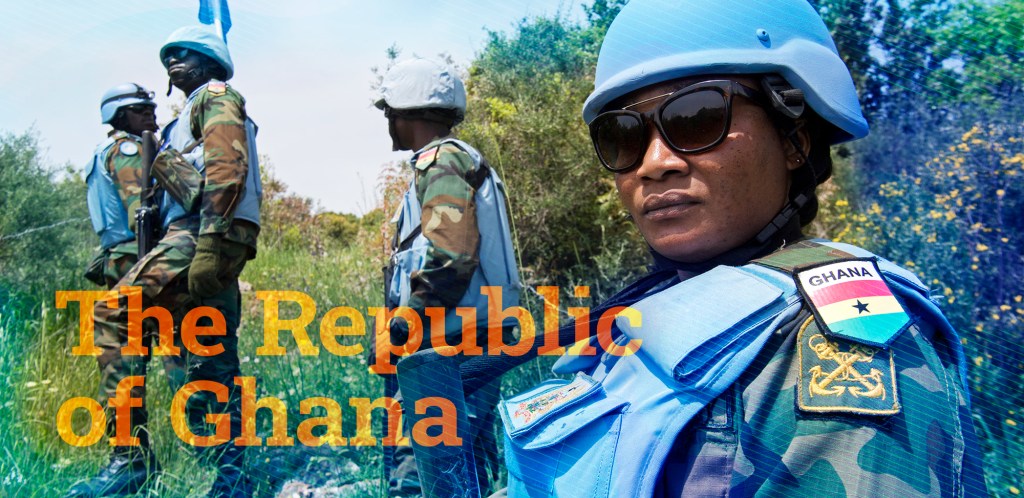
This project profile page contains information about The Republic of Ghana Armed Forces project including project results, impact, and effective practices. This page will be updated annually in line with EIF project reporting requirements.
| T/PCC | Updates | |||||||||
| 2020 | 2021 | 2022 | 2023 | 2024 | ||||||
| Total | % | Total | % | Total | % | Total | % | Total | % | |
| Ghana | 401 | 15.44% | 369 | 16.27% | 420 | 15.78% | 441 | 15.98% | 433 | 16.33% |
|---|---|---|---|---|---|---|---|---|---|---|
| Experts on Mission | 15 | 36.59% | 18 | 40.91% | 17 | 36.17% | 17 | 35.42% | 16 | 33.33% |
| Formed Police Units | 50 | 19.23% | 62 | 23.05% | 41 | 15.30% | 55 | 20.52% | 58 | 21.48% |
| Individual Police | 44 | 52.38% | 18 | 36.00% | 16 | 48.48% | 15 | 42.86% | 12 | 32.43% |
| Staff Officer | 24 | 29.63% | 25 | 30.49% | 25 | 27.78% | 19 | 19.00% | 18 | 21.69% |
| Troops | 268 | 12.58% | 246 | 13.49% | 321 | 14.44% | 335 | 14.51% | 329 | 14.87% |
Ghana is widely recognised as a committed and experienced Troop- and Police-Contributing Country (T/PCC), with decades of active engagement in United Nations and regional peace operations. Since its first deployment in the 1960s, the Ghana Armed Forces (GAF) has regularly contributed personnel to international and regional missions, demonstrating sustained support for global peace and security. Peacekeeping remains a national priority—following internal and regional stability—and is valued not only as a source of international credibility, but also as a means of professional development for military personnel. The GAF, comprising the Army, Navy, and Air Force, operates under the Ministry of Defence and is structured through decentralised commands across its three services.
Over the years, Ghana has made steady progress in promoting women’s participation in the armed forces and peacekeeping. A 15% recruitment quota, together with frameworks such as the Armed Forces Act, the National Gender Policy, and the National Action Plan on UNSCR 1325, has helped institutionalise gender inclusion. Since 2017, the GAF has consistently deployed 14–15% women in formed units and 20–23% in staff and observer roles. While deployment is shaped by mission needs and available qualified personnel, Ghana continues to prioritise gender equality in line with its Women, Peace and Security (WPS) commitments. The promotion of women to senior ranks, including the appointment of Brigadier Generals, signals growing momentum toward inclusive leadership within the military.
The GAF project aimed to increase the meaningful participation of uniformed women in United Nations Peace Operations by addressing key barriers identified in the 2020 Measuring Opportunities for Women in Peace Operations (MOWIP) barrier assessment—specifically the limited eligible pool of women and insufficient infrastructure.
The GAF project concluded in October 2024. The project delivered key results, including the construction of two dedicated accommodation facilities for women recruits, a nationwide recruitment campaign, and the deployment of two rotations of a GSU to UNIFIL. These efforts significantly increased GAF’s training capacity and helped expand the pool of eligible women for peacekeeping deployment. The project’s activities directly supported Ghana’s commitments under its NAP on WPS (2020–2025) and established a foundation for continued institutional progress toward gender-responsive peace operations.
EIF OUTCOME 2
GSU DEPLOYMENT AND MEANINGFUL PARTICIPATION
GSU
to UNIFIL
1 GSU deployed to UNIFIL from September 2023 to September 2024 with 20 per cent women’s representation – 176 women
These uniformed women participated in the battalion’s pre-deployment training and were fully integrated into the unit at all levels, including in leadership, combat, and operational roles
EIF OUTCOME 3
GENDER-SENSITIVE INFRASTRUCTURE
women's
accommodation
construction
Construction of the women’s accommodation facility at the Army Recruit Training School (ARTS) is complete.
The building, which will be inaugurated in Q1 2025, can accommodate 200 additional beds for women (260 beds total)
Construction of the women’s accommodation at Daboya Training Camp is complete, with inauguration in Q2 2024.
The building can accommodate 100 additional beds for women (200 beds total)
EIF OUTCOME 3
RECRUITMENT AND SENSITISATION
media
campaign
1 national media campaign developed (including radio, TV adverts, social media) to launch the national recruitment campaign with specific messaging for women
high-school
students
21,470 high-school and tertiary education students (6,189 boys and 15,281 girls) were sensitised in 11 regions of Ghana to encourage them to join combat and combat support roles
commanders
sensitised
21 commanders sensitised to increase the female percentage quota for recruitment
% increase in women
recruitment
17,163 high-school and tertiary education students (6,195 boys and 10,968 girls) were sensitised in two regions of Ghana to encourage them to join combat and combat support roles
EIF OUTCOME 2
GSU DEPLOYMENT AND MEANINGFUL PARTICIPATION
GSU
to UNIFIL
One GSU (Ghana Battalion 89 (GHANBATT 89)) deployed to UNIFIL with 19 per cent women’s representation – 165 women (total battalion size of 862) in 2022-2023. The GAF redeployed a GSU to UNIFIL—GHANBATT 89—in September 2023 with 20 per cent women’s representation – 176 women. These uniformed women participated in the battalion’s pre–deployment training and were fully integrated in the unit at all levels, including in leadership, combat, and operational roles
EIF OUTCOME 3
GENDER-SENSITIVE INFRASTRUCTURE
women's
accommodation
construction
Construction of the sub-structure of a women’s accommodation at the Army Recruit Training School (ARTS) is 100% complete. The building will accommodate 200 additional beds for women (260 beds total). Construction of both sub-structure and superstructure of women’s accommodation at Daboya
Training Camp is 100% complete.The building will
accommodate 100 additional beds for women (200 beds total)
EIF OUTCOME 3
RECRUITMENT
media
campaign
products
10 media campaign products (including radio, TV adverts, and T-shirts) developed to launch the national recruitment campaign with specific messaging for women in in Q1 2024
EIF OUTCOME 3
SENSITISATION
high-
school
students
17,163 high-school and tertiary education students (6,195 boys and 10,968 girls) were sensitised in two regions of Ghana to encourage them to join combat and combat support roles
EIF OUTCOME 2
GSU DEPLOYMENT AND MEANINGFUL PARTICIPATION
GSU
to UNIFIL
One GSU (Ghana Battalion 89 (GHANBATT 89)) deployed to UNIFIL with 19 per cent women’s representation – 165 women (total battalion size of 862) in 2022-2023.
US$3,700,669
US$1,484,984
GAF – Kofi Annan International Peacekeeping Training
Centre (KAIPTC)
GAF – KAIPTC
GAF – KAIPTC
FPF – 22 months; GSU – 36 months
1 September 2022
28 October 2022
31 October 2024
24 months – Flexible Project Funding (FPF);
24 months – GSU
(includes two approved revisions: a budget revision and a no-cost extension)
The project contributed to ongoing efforts to enhance gender inclusion and equality in the Ghana Armed Forces (GAF) by increasing training capacity, promoting the recruitment of women, and addressing gender stereotypes. It laid the groundwork for expanding the pool of eligible women, including in combat and combat support roles, and is expected to support future progress toward Ghana’s goal of raising women’s representation in the GAF to 25% by 2028 and increasing their participation in United Nations peace operations.
Ghana National Gender Policy, May 2015
Ghana Armed Forces Gender Policy, 13 March 2025
Elsie Initiative Fund supports Construction of 100 Bed Women’s Accommodation, Daboya Training Camp, 1 June 2024
Ghana Army, Elsie Initiative Fund Commission 200-Bed Female Accommodation for ARTS, Shai Hills, Ghana Peace Journal, 26 January 2025
Ghanaian women peacekeepers deployed to UNIFIL as part of GHANBATT 90—a Gender-Strong Unit—demonstrated resilience and leadership, reinforcing the critical role of women in peace operations, February 2024
The GAF completed a MOWIP barrier assessment in 2022, funded by Global Affairs Canada and the Norwegian Ministry of Foreign Affairs.
Ghana Armed Forces MOWIP Barrier Assessment Report, 2021
English
