Elsie Initiative Fund - Project Profiles

This project profile page contains information about The Republic of Niger Armed Forces and Police project including project results, impact, and effective practices. This page will be updated annually in line with EIF project reporting requirements.

The Republic of Niger Armed Forces and Police

Results Dashboard

Last Updated: 31 December 2024

T/PCC Ranking

57

Personnel Deployed

87

Women #

34

Women %

39.53%

TCC Ranking

88

Military Personnel

9

Women #

2

Women %

22.22%

PCC Ranking

14

Police Personnel

77

Women #

32

Women %

41.56%
Data source: United Nations Peace Security Data Hub, a free public library of datasets on peace and security published by the United Nations
T/PCC Updates
2020 2021 2022 2023 2024
Total % Total % Total % Total % Total %
Niger 52 5.31% 34 3.47% 27 2.81% 44 5.67% 34 39.53%
Experts on Mission 0 / 0 / 0 / 0 / 0 /
Individual Police 40 40.40% 29 30.21% 19 23.75% 35 39.33% 32 41.56%
Staff Officer 0 / 0 / 2 9.52% 2 10.53% 2 25.00%
Troops 12 1.39% 5 0.58% 6 0.70% 7 1.05% 0 /

Niger Armed Forces and Police

Niger’s security sector is comprised of the Armed Forces (Forces Armées Nigériennes – FAN), the National Gendarmerie, the National Guard, and the National Police. The FAN, which includes the Army and Air Force, along with the National Gendarmerie, operates under the Ministry of Defense (MOD). The National Guard and National Police fall under the Ministry of the Interior (MOI). As a Troop-Contributing Country (TCC), Niger has consistently supported both regional and United Nations peace operations, deploying military personnel to missions such as MINUSMA (Mali), MONUSCO (DRC), and UNOCI (Côte d’Ivoire). Niger is also an active Police-Contributing Country (PCC), regularly deploying individual police officers to UN peacekeeping missions, including MINUSMA, MINUSCA, and MONUSCO. 

Niger has made progress in integrating women into its armed forces and police. Female personnel are present in the military, police, and gendarmerie, and some have been deployed in UN peacekeeping roles, particularly as individual police officers. However, structural and socio-cultural barriers continue to limit women’s recruitment, promotion, and peacekeeping deployment. In response, efforts are underway to improve gender-sensitive recruitment policies and institutional support for women in uniform.  

These advancements align with Niger’s broader commitments under its National Action Plans on Women, Peace, and Security. The first NAP (2016–2018) focused on institutionalizing gender considerations in national security and promoting women’s participation in peace processes. The second NAP (2020–2024) built on this foundation, emphasizing women’s leadership in conflict prevention, strengthening protection mechanisms against gender-based violence, and integrating gender into national and local governance systems. 

Project Overview

The EIF-funded project with the Niger Armed Forces and Police, supported by UN Women Niger, combined a barrier assessment with targeted project funding. The initiative aimed to address key obstacles to women’s meaningful participation in security institutions by establishing a roster of trained women eligible for deployment to peace operations and by increasing the recruitment of women within the Niger Armed Forces and Police. 

The flexible project funding aimed to deliver the following outputs: 
1. A combined barrier assessment for the armed forces and police using the MOWIP methodology 
2. A study on women’s interest in and motivation for careers in national uniformed services 
3. Development of a gender equality policy for the police and armed forces 
4. Establishment of a roster of 40 female soldiers and 100 female police officers for deployment to peace operations 
5. Recruitment outreach to 10,000 women through a public information and awareness campaign 
6. Capacity building and training for 200 women during the recruitment process, with a target of a 10% increase in the armed forces and 15% in the police (baseline: 4.69% women in the military in 2020; 5% in the police in 2019) 
7. Training for 100 women police officers to prepare for AMS-SAAT examinations and 40 women military officers in areas such as civil-military cooperation, engineering, and communications. 

However, the project was terminated in 2023 following the coup d’état in Niger in July of that year. 
Filter by year:

2023 Key Results

EIF OUTCOME 3
RECRUITMENT
0

young women
supported

200 young women supported through the provision of
“safe kits”, transportation and registration fees in the
recruitment process to join the Niger Armed Forces

EIF OUTCOME 3
CAPACITY-BUILDING TRAINING

0

women
troops trained

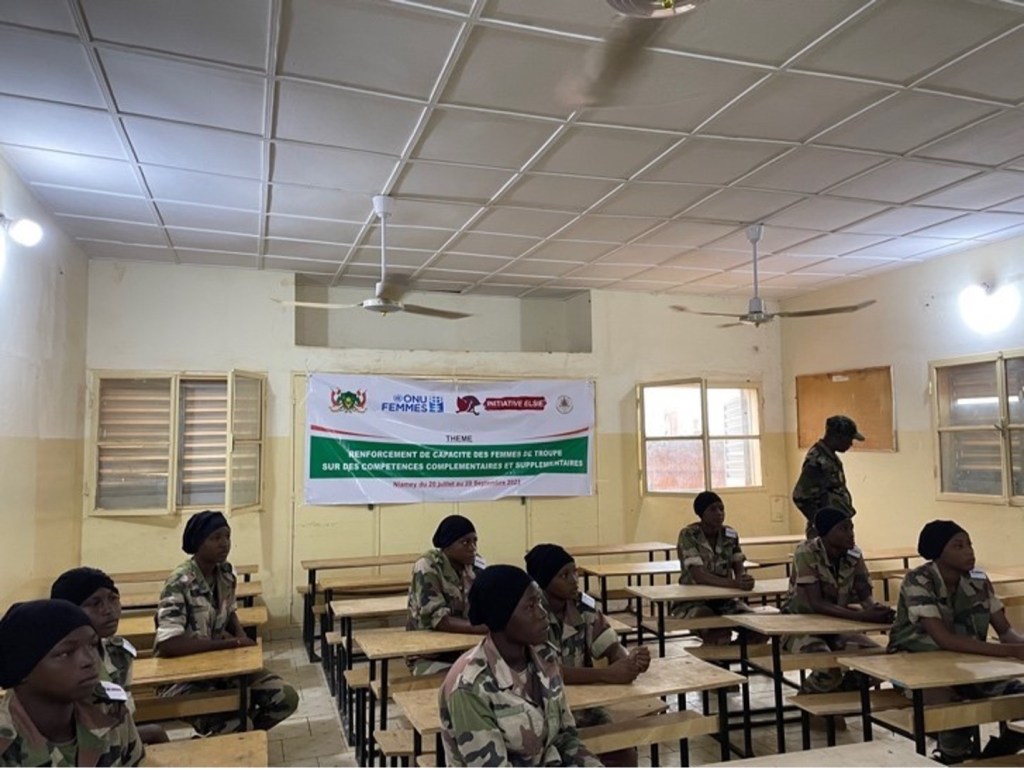
40 women troops trained in plumbing, computing, and information technology (IT), engineering, mechanics, and civil-military cooperation to enhance their readiness for peacekeeping deployment and advance their careers within the Armed Forces

PROJECT STATUS

Terminated

EIF Results Framework
EIF Outcome 3
Total Approved EIF Budget

US$ 96,052

Funds transferred as of 31 December 2023

US$996,052

Beneficiary

Niger Ministries of Defence and Interior

Fund Recipient

UN Women Niger

Implementing Partner

National Institute of Statistics (NIS)

Planned Project Duration

12 months

Project Approval Date

27 April 2021

Project Start Date

14 July 2021

Project End Date

31 December 2023

Project Revision(s)
  1. 30 October 2022: No-cost extension:  16 months 
  2. 31 October 2023: No-cost extension: 2 months  
Total Project Duration

30 months

Project Deliverables
  1. Combined BA report and recommendations for the Niger Armed Forces and Police
  2. Study on women’s interests and motivations for a career in the uniformed services
  3. Development of a gender policy, strategy, and action plan for the police and armed forces
  4. Outreach to 10,000 women for a career in the uniformed services and training support to 200 women candidates for recruitment
  5. Training for 100 women police officers on the UN Assessment in Mission Service – Selection, Assistance, and Assessment Team (AMS-SAAT) examination, and 40 women soldiers on civil-military cooperation, engineering, signals, and other specializations
  6. Pool of 40 women soldiers and 100 women police officers eligible and trained to be deployed to UN peace operations
Impact
The project contributed to enhancing recruitment, training, and career advancement opportunities for women through supporting 200 women in the recruitment process to join the Niger Armed Forces and training 40 women in plumbing, computing and mechanics to advance their careers within the Armed Forces.

Documents

National WPS Framework

Communications

Project Approval Press Release: 28 April 2021

English – French

Links

EIF Annual Reports by Year

MPTFO Project Page

National Action Plan (NAP)

MOWIP

The Niger Armed Forces and Police were not able to conduct the Measuring Opportunities for Women in Peace Operations (MOWIP) assessment as the project was terminated in 2023 due to the coup d’état in Niger in July 2023.

Niger Armed Forces – Technical Skills Training for Women, July 2023

Niger Armed Forces – Technical Skills Training for Women, July 2023

Translate »