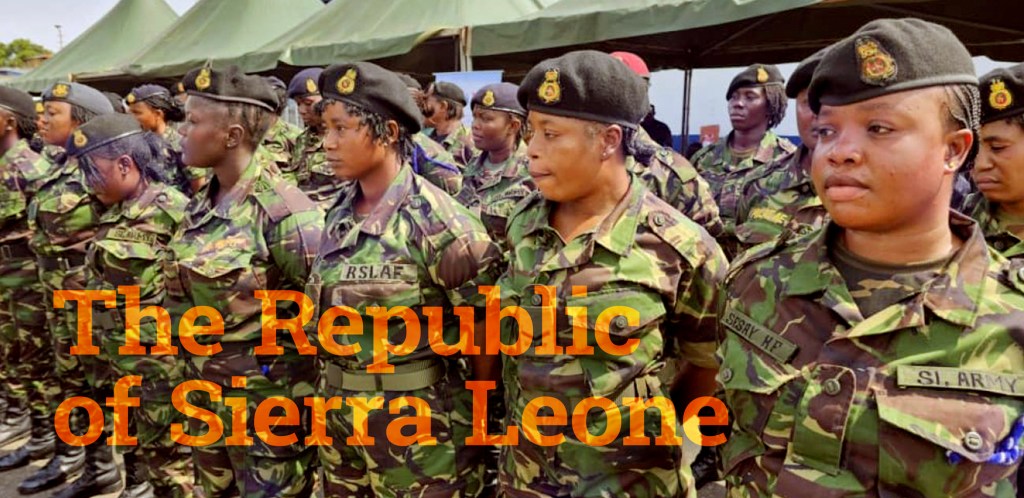
This project profile page contains information about The Republic of Sierra Leone Armed Forces project including project results, impact, and effective practices. This page will be updated annually in line with EIF project reporting requirements.
Data source: United Nations Peace Security Data Hub, a free public library of datasets on peace and security published by the United Nations
T/PCC
Updates
2020
2021
2022
2023
2024
Total
%
Total
%
Total
%
Total
%
Total
%
Sierra Leone
31
38.27%
36
53.73%
42
62.69%
21
45.65%
19
47.50%
Experts on Mission
10
71.43%
8
72.73%
7
70.00%
7
58.33%
6
60.00%
Individual Police
13
37.14%
20
80.00%
27
93.10%
7
87.50%
9
45.00%
Staff Officer
8
25.00%
8
25.81%
8
28.57%
7
26.92%
4
40.00%
Sierra Leone Armed Forces
The Republic of Sierra Leone Armed Forces (RSLAF) is the country’s national military institution, overseen by the Ministry of Defence. It is responsible for national defence and contributes to regional security efforts. The RSLAF has also engaged in international partnerships and training initiatives aimed at strengthening its operational capacity and institutional development.
In recent years, the RSLAF has taken steps to strengthen its approach to gender equality, including examining its internal structures and practices through institutional assessments and reviews. These efforts reflect a growing focus on understanding how gender influences recruitment, retention, promotion, and workplace culture within the armed forces.
The RSLAF established a Gender and Equal Opportunities Directorate in 2009, which has since developed several key policies. These include a Gender Policy (2009), a Sexual Harassment and Exploitation Policy (2013), and a Fraternisation Policy. Each is designed to support gender equality, safeguard personnel from harassment and exploitation, and uphold standards of conduct and discipline across the institution.
The RSLAF has also partnered with national and international stakeholders to assess the gender responsiveness of its policies and practices. This included a 2018 review led by the University of Sierra Leone and a subsequent barrier assessment supported by the Elsie Initiative Fund and UN Women. These initiatives were undertaken to generate evidence, strengthen institutional understanding, and support national-level dialogue on gender equality in the defence sector.
Project Overview
The RSLAF, in partnership with UN Women Sierra Leone, undertook a comprehensive barrier assessment using the Measuring Opportunities for Women in Peace Operations (MOWIP) methodology developed by the Geneva Centre for Security Sector Governance (DCAF) and Cornell University Gender and Security Sector Lab (GSS Lab, to better understand the challenges affecting women’s meaningful participation in United Nations Peace Operations. The research was conducted by Dr Hindowa Momoh from the University of Sierra Leone, in collaboration with Cornell University, using Partnership model A.
The assessment aimed to:
1. Identify the main barriers to women’s meaningful participation within the ten issue areas outlined in the MOWIP methodology; 2. Identify existing good practices within the RSLAF that could be leveraged, scaled up, or shared more broadly; 3. Formulate a set of evidence-based recommendations for future activities to increase the participation of RSLAF women in United Nations peace operations; and 4. Provide a baseline to measure progress in overcoming barriers to women’s participation.
Following the assessment, the RSLAF developed an Action Plan to implement its recommendations, with defined objectives, timelines, and responsibilities. The project is also expected to support future participation in the Elsie Initiative Fund (EIF) to enhance the meaningful participation of uniformed women in United Nations Peacekeeping Operations.
Filter by year:
2022 Key Results
EIF OUTCOME 1 EXPANDED COUNTRY-KNOWLEDGE OF BARRIERS TO DEPLOYMENT
0
surveys
385 surveys administered by the MOWIP enumerator team (196 men and 189 women)
0
interviews
30 interviews conducted with senior leadership, decision makers and program officers (14 women and 16 men)
0
MOWIP report
1 MOWIP report launched on 22 November 2022
0
senior leadership personnel
more than 500 senior leadership personnel and government officials attended three regional dissemination meetings to learn about the MOWIP report’s key outcomes
PROJECT STATUS
Completed
EIF Results Framework
EIF Outcome 1
Total Approved EIF Budget
US$184,677
Funds transferred as of 31 December 2022
US$184,677
Beneficiary
RSLAF
Fund Recipient
UN Women Sierra Leone
Implementing Partner
University of Sierra Leone
Planned Project Duration
7 months
Project Approval Date
15 April 2021
Project Start Date
17 May 2021
Project End Date
15 December 2022
Project Revision(s)
11 August 2022: no-cost extension: 11 months through 15 December 2022
Total Project Duration
19 months
Project Deliverables
MOWIP Barrier Assessment Report and recommendations
Results and Impact
The barrier assessment generated a comprehensive, evidence-based analysis of the challenges and opportunities influencing the participation of uniformed women in the RSLAF in peace operations. Since completion, the RSLAF developed a national strategy and action plan to address key barriers identified in the MOWIP report, appointed the first female officer as a member of the Ministry of Defense/RSLAF decision-making committee and appointed the first female battalion second-in-command.
Awareness and dissemination of the assessment findings were conducted nationwide, including regional meetings in Kenema, Bo, and Makeni, and involved not only the security sector but also civil society, local stakeholders, and the wider public.